


My legs often swell. By the end of the day, it feels like weights are suspended from them. I have cramps at night.
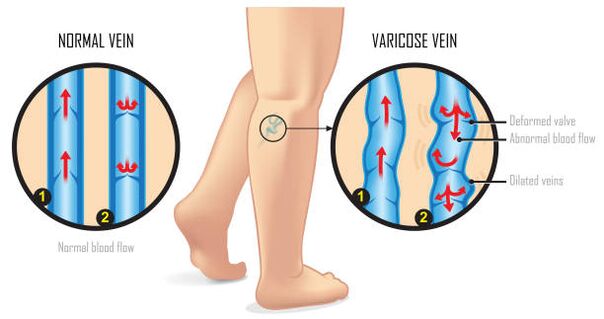
These symptoms usually begin with varicose veins - a disease in which the diameter of blood vessels increases and blood circulation worsens. Why does it occur? People rarely think about how blood moves through the vessels.It seems to flow from the heart to the organs and back freely.Unimpeded. Blood actually flows quickly through the arteries due to high pressure.With veins it's different.
Through these vessels, blood rises to the heart from the extremities and it is similar to swimming against the current.Gravity interferes with blood circulation.Therefore, the vessels have special valves that retain blood and do not allow it to flow down.
Sometimes the valve system fails and becomes damaged or weakened.The valves allow too much blood to pass down, which accumulates, puts pressure on the venous walls and gradually dilates the vessels.Veins also become swollen for other reasons.For example, when the venous wall is damaged, it cannot withstand blood pressure and stretches.
Doctors distinguish several types of varicose veins of the legs:
- Non-safen varicose veins- enlargement of superficial vessels that are not part of the system of the great or small saphenous vein;
- Reticular varicose veins- swelling of small saphenous veins;
- Spider veins or telangiectasia- expansion of intradermal veins.
At first, any type of varicose veins seems to be a minor problem, since it causes minor physical and cosmetic discomfort.Heaviness in the legs, pain, swelling.Blue or red patterns of veins on the surface of the skin. Sounds harmless. However, without treatment, the disease inevitably progresses - sometimes over months, sometimes over decades.Complications arise:
- Vein thrombosis and pulmonary embolism
Blood circulation in dilated vessels is impaired.Blood clots often form - blood clots that block veins, and occasionally break off and float to the heart and lungs.If they block blood flow to vital organs, this can even lead to death.
- Trophic ulcers
Non-healing wounds near dilated vessels.Varicose veins disrupt the metabolism in the surrounding tissues, so that part of the skin dies.It is very difficult to cure such ulcers because after treatment they often appear again.They heal and become inflamed again.
- Bleeding
Individual superficial varicose veins rupture and mild bleeding occurs.
You can easily prevent any complications of varicose veins - just go to a phlebologist at the first signs of the disease.Be especially careful if you are at risk.
Risk factors
Not all people are equally susceptible to varicose veins.Some people get sick often, others never.The main role in the development of the disease is played by hereditary weakness of the venous valves, which are often damaged due to external factors.
People with this defect do not get sick right away.Some lucky people live for decades and do not have problems with veins.Other people with a weakened valve system are forced to struggle with varicose veins throughout their lives.
Risk factors hinder them:
- Age
Research shows that the likelihood of varicose veins increases with age.Due to aging, venous valves become damaged and become detached.New ones don't grow.The fewer valves, the more blood is retained in the vessels.
- Floor
Women suffer from varicose veins more often than men.Hormonal imbalance is to blame.Hormones relax the vein walls and increase the risk of vasodilation.Any hormonal drugs, for example, contraceptives, make veins more vulnerable.
- Pregnancy
Another bad news for women.Pregnancy is not only an opportunity to become a mother, but also a great burden on the body.The amount of blood increases.The pressure on the vein walls increases and they often expand.
- Obesity
Overweight people face problems similar to those of pregnant women.There is a lot of blood in the body.The greater the volume of blood, the more pressure it puts on the walls of blood vessels.Many more obese patients move little.This factor also increases the likelihood of varicose veins and poor circulation.
- Long immobility
The blood in the veins flows towards the heart not only because of the valves, but also because of the movement of muscles.They contract and push the blood upward.When people stand or sit for a long time without moving, their muscles do not work.As a result, it often stagnates in the vessels.
Some risk factors, such as age and gender, always loom over people like the blade of a guillotine.The influence of other factors can be reduced.
To reduce the risk of varicose veins, doctors recommend:
- Do exercises daily;
- Monitor your weight and fight obesity;
- Do not wear tight clothes or shoes that interfere with blood circulation;
- Change your position regularly if you sit or stand for a long time.
At a minimum, these tips will help delay the joyless moment of becoming acquainted with swollen veins.Remember the symptoms of the disease.Knowing them will allow you to consult a doctor in time.
Portrait of varicose veins.Signs of illness
Varicose veins affect hundreds of millions of people around the world, and every year this club is replenished with new members.Why?
Because the signs of the disease do not seem dangerous.In many patients, varicose veins do not cause discomfort, since only external signs appear:
- Purple or blue veins on the surface of the skin;
- Twisted and swollen vessels, like cords.
It sounds unpleasant, but as long as the symptoms are hidden under clothing, people tend to ignore them.At least for a while.It is much more difficult to turn a blind eye to the signs of illness when:
- Pain and heaviness in the legs;
- Itching around diseased vessels;
- Burning, swelling and spasms in the lower leg;
- Severe pain when moving after a long period of immobility;
- Change in skin color near the varicose vein.
Symptoms are not constant.Sometimes they get worse, sometimes they subside.In summer, the signs of varicose veins usually manifest themselves in full force, and in winter, the disease does not bother patients so much. However, this is not a reason to avoid the doctor. Any types of varicose veins of the legs are just the tip of the iceberg.Real problems begin with complications that not only cause discomfort, but also directly threaten the patient’s life. We recommend contacting a phlebologist at the first signs of varicose veins.At an early stage, the disease is easily treated.Even without surgery. Quick treatment has other benefits. You won't have to worry about the cosmetic discomfort of bulging veins that are visible.And you won’t have to worry about complications, which often lead to hospitalization.They attack in the later stages of the disease.
Deadly progress.Stages of varicose veins
There are many classifications of varicose veins used around the world.We will talk about two classifications.
Let's start with the oldest.
- First stage or compensation
Small spider veins appear on the legs and thighs, which are accompanied by swelling and a feeling of heaviness.The blood flow is not impaired.
- Second stage or subcompensation
Vessels in different parts of the legs dilate - not only the superficial, but also the connecting veins are affected.Constant swelling, dilated blood vessels rise above the surface of the skin.Diagnostics shows weakening of the venous valves.
- Third stage or decompensation
All signs of blood stagnation in the veins appear: heaviness in the legs, swelling, fatigue, pain, cramps, itchy skin.Full range of trophic skin disorders.Even trophic ulcers are formed.
The second classification is more extensive and consists of seven stages.It's called CEAP.Each letter in this acronym represents a characteristic of the disease:
- C—clinical stage;
- E - cause of varicose veins;
- A - anatomy of the lesion;
- P—pathophysiology.
Accordingly, each stage of the disease has its own characteristics.
Stage 0
The most unusual stage in the development of the disease.In fact, doctors cannot prove that the patient is really sick. There are no external signs of varicose veins and they cannot be detected even with the help of ultrasound diagnostics. However, there are still symptoms.At the initial stage of varicose veins, the patient is bothered by swelling, heaviness in the legs and cramps at night, which do not always indicate problems with blood vessels.Therefore, it is impossible to diagnose the disease at this stage.
Stage 1
Spider veins with a diameter of less than 1 mm are clearly visible on the skin, and reticular veins sometimes expand to 3 mm in diameter.In rare cases, external symptoms include swelling, night cramps, and pain. Not all doctors recognize the first stage of varicose veins as real varicose veins, since spider veins do not always form due to problems with the venous valves.
Stage 2
It is from the second stage of varicose veins that varicose veins with a diameter of 3 mm appear.Sometimes more. Blue nodules of dilated vessels are clearly visible on the skin.They may increase and disappear.Veins appear especially clearly after working at a computer for a long time and wearing uncomfortable, tight, high-heeled shoes. Patients often develop blood clots.
Stage 3
All symptoms characteristic of previous stages of the disease occur.Varicose veins develop.Now the swelling in the legs does not disappear.The skin of diseased vessels swells especially strongly in the evenings, but even during the day wearing shoes and tight clothes is not very comfortable. The third stage of varicose veins seems to indicate that skin problems will only get worse in the future.
Stage 4
The nutrition of tissues near varicose veins is disrupted.They do not receive the necessary substances, resulting in trophic changes:
- Lipodermatosclerosis;
- Eczema;
- Darkening or discoloration of the skin.
The fourth stage of varicose veins is characterized by radical changes in the color of the skin.A large amount of pigment accumulates in the skin and it can turn dark brown or black, or vice versa.The pigment does not reach the skin and it atrophies - it acquires a painful white color. Certain areas of the legs do not just change color.They also become inflamed.Small red spots or large weeping lesions form on the skin. Without treatment, these symptoms constantly worsen and cause trophic ulcers.
Stage 5
Signs of the previous stages of the disease remain, and in addition, trophic ulcers are formed that heal quickly.However, it’s too early to rejoice.Until the disease is cured, new ulcers will appear. The fifth stage of varicose veins is one of the most severe.Pain in the legs, twisted, swollen veins and other symptoms bother the patient around the clock.
Stage 6
The trophic ulcer no longer heals.Now an ugly wound constantly sticks out on the body of a patient with varicose veins.This is no longer just a cosmetic defect, but complete tissue death, which is accompanied by fever, pain and purulent discharge.It is extremely difficult to get rid of it. To restore health from the sixth stage of varicose veins, long-term treatment will be required.Without eliminating the disease, the ulcer will not disappear forever.There are many cases where doctors used the correct therapy, but the ulcer returned again and again.
The phlebologist's trumps up his sleeve.Treatment methods for varicose veins
After diagnosis, the phlebologist not only determines the stage of the disease, but also chooses a treatment method.Patients with varicose veins in the early stages do not need surgery.Conservative treatment is used. The doctor prescribes compression stockings, medications and recommends special exercises.This removes the symptoms of varicose veins.The development of the disease is stopped and complications are prevented. In severe cases, such methods no longer help and the phlebologist uses trump cards - modern, low-traumatic methods of treating varicose veins.
Microsclerotherapy
- Indications
The procedure is prescribed against spider veins.This is the name given to thin vessels on the surface of the skin, usually red or blue.Microsclerotherapy does not eliminate large varicose veins, only cosmetic defects.
- Progress of the procedure
The doctor injects sclerosant into the dilated vessels using a needle with a diameter of up to 0.3 mm.This substance destroys the inner walls of the veins, so that the vessels stick together and disappear.Skin manifestations also disappear.
- Advantages
The procedure shows excellent results - it removes up to 98% of manifestations.Yes, not right away.All marks on this area of skin disappear within 4 weeks.No scars.The operation is safe and painless.
Endovasal laser coagulation
- Indications
The procedure is effective for varicose veins of no more than 10 mm, and it also removes vascular tumors - angiomatosis, hemangiomas, etc.Some doctors treat trophic ulcers with laser coagulation.
- Progress of the procedure
A phlebologist uses a catheter with a laser.He inserts this device inside the diseased vessel and seals its walls, after which the vein closes and stops pumping blood.Blood flow is redirected.The procedure lasts up to 40 minutes and is performed under local anesthesia.
- Advantages
Painless and safe operation.There are no scars, hematomas or other traces left at the catheter insertion site.Patients do not need long rehabilitation - they go home after 3 hours and go to work after 1 day.
Foam sclerosis
- Indications
The method of treating different types of varicose veins is when the veins are dilated more than 10 mm.Helps remove varicose veins.
- Progress of the procedure
The doctor injects sclerosant into the vessel in foam form.The substance coats the venous walls and destroys them, after which the inflamed vein closes and blood circulation in it stops.The foam covers a large area and is quickly absorbed.Low risk of complications.
- Advantages
The foam easily fills and covers even large veins.In just 20 minutes or less.A safe and painless procedure that does not leave scars or other marks.
Miniphlebectomy
- Indications
This is one of the main methods for treating large veins with a diameter of up to 18 mm.Helps remove swelling.Restores normal blood flow.Doctors prescribe miniphlebectomy after eliminating thrombophlebitis of the subcutaneous trunks.
- Progress of the procedure
The phlebologist pierces the skin opposite the diseased vessels.The diameter of the holes does not exceed 1-2 mm.The doctor grabs the vein with special hooks, pulls the affected area out and removes it.He cuts off one segment of the vessel after another.Local anesthesia is used.The wounds are covered with medical tape, and the patient wears compression stockings on top.
- Advantages
Complete removal of diseased veins in 1 hour or less.After the procedure, small bruises remain on the skin, but even these disappear within 2 weeks.The patient recovers completely within 10 days.
Phlebologists will cure varicose veins at any stage
Varicose veins appear in people of any age, but most often affect adult men and women.And most often women.We have already mentioned this. Not all people want to undergo treatment. Why? It’s very simple - in the initial stages, varicose veins do not cause severe discomfort.In addition, its symptoms are similar to those of other diseases, which complicates diagnosis. But even with more severe symptoms, people do not always rush to consult a phlebologist.Because they are afraid of surgery.Or they think that treatment will be expensive. However, the disease does not stand still and continues to actively develop, especially if the patient exposes himself to risk factors.The further the disease progresses, the more difficult it is to get rid of it. In the early stages, varicose veins can be cured without surgery.The latter will require surgical intervention and long-term treatment of trophic ulcers. The conclusion is simple - you need to get rid of varicose veins as early as possible. Who should you contact? Varicose veins and other vascular diseases are treated by a phlebologist.Residents of large cities can easily find several clinics where they can eliminate bloating of veins.You just need to choose the best one.Ask for advice from relatives and friends - among them there are probably people with diseased blood vessels.